Showing posts with label BMW. Show all posts

Friday, March 16, 2012

[PROJECT] TOYOTA VS BMW


At this point, I would like to take the time to make some specific observations about the BMW plant tour we took on Wednesday in Munich.  I would also like to make some comparisons to the Toyota plant tour I took three weeks ago.

The BMW Tour began at BMW Welt, just next to the main headquarters for all of BMW Group.  This was the first big difference from Toyota, whose plant was only the American headquarters (not the corporate headquarters).  The tour officially began with a company overview video, similar to how the Toyota tour began.  While Toyota began within the weaving and textile industry, BMW began by manufacturing airplane engines in the early 1900s.  Eventually the plant would evolve, especially after the two world wars that would greatly affect Europe, Germany, and the car company itself.  Many dark periods exist in BMW’s past, including one during World War II when they utilized forced labor to fuel the German war machine.  Today, such periods are highlighted well in their museum, and the company has taken many reconciling initiatives since that era.  Going into the 1950s, they began to really place a focus on their vehicles and developing a car company.  At one point, the company about went under, but they rebounded.  Today, BMW is an international company and a name most people are familiar with and associate with quality, performance, and luxury.  BMW has plants and distributors in many countries worldwide, with their headquarters located in the northern part of Munich.  Back in its younger years, the plant was outside of Munich’s city center.  Since that time, Munich has grown exponentially, and BMW now rests in the midst of a major Munich suburb.  Residential areas surround the plant, limiting its geographic growth.  This poses many interesting issues for BMW that most other companies do not have to face. 

Press Shop (Presswerke)

After the video, we left for the factory and entered the press shop.  Like Toyota and many other car companies, they begin their process with giant steel coils which are unrolled, cut, stamped, and trimmed to form car body sections.  The press room in BMW was large and clean.  Sunlight was able to enter the room through a number of semitransparent roof sections.  The plant floor had stacks of BMW designed and manufactured press tools and dies.  These are inserted into the presses as car models change and different batches must be produced.  Typical car panels would take three to five press cycles to be completely formed and trimmed.

Welding (Schweißwerkstatt) and Body Shop (Karosseriebau)

Following the stamping production, we were taken to welding.  Here the body sections are taken and welded together.  The car body starts with the floor section.  The sides and columns are welded together separately.  In the end step, the floor, sides, and roof are all welded together.  Almost no workers were in sight during this welding process, and everything was very easy to observe.  Transparent protective walls surrounded all of the welding robot arms.  In Toyota, the process was similar, only it was nearly impossible to see through the guards because they were covered with so much soot.  Another unique part of the BMW process was the use of a sliding assembly line and sliding jigs.  For example, when the car sides and roof were being welded onto the car floor, precision holding fixtures and jigs would hold all of the pieces together within a fraction of a millimeter.  After the weld sequence finished, the car would move to the next welding location.  In the event that a car type/model changed, the jig that held the body pieces together would slide down along with the car and a new jig would replace it in the first weld stage.  The process of changing jigs and the car moving down the line occurred almost simultaneously.  This cut down on the space required for jigs and the processing time. 

In terms of a quality control and measurement, bright lights and high resolution cameras would take pictures of each important weld and upload the images to a database.  Between digital processing and actual human observation, the quality of each fastened, welded, or glued section could be checked before the car was sent to final production.  Should quality deteriorate, corrective measures could be taken.

Paint (Lack)

After welding was paint.  Again, the cars on the line moved in batches (unlike the sequencing used in Toyota).  There would be a batch of white sedans and then a batch of black sedans.  All facets of the paint process were similar to Toyota.  First an acid bath of Zinc Phosphate removed all weld debris and films preparing the surface for the anti-corrosion dip.  Second, another acid bath (cathodic dip bath) would chemically treat the steel surface.  Following this step, the primer was applied, followed by a base coat and gloss finish.  The painting booths were very technologically advanced.  All vehicles were given negative ground charges while the chemicals were positively charged as they left spray nozzles. To ensure a wide and even coat of paint, the paint was discharged from atomizing (like a perfume bottle) nozzles that spun at nearly 40,000 RPMs.  This was very unique, but ensured a perfect coat of paint.  Each paint booth was also pressurized to ensure excess paint was pushed down into a waterfall like drain below each station.  The excess paint and water were then filtered and treated so that very little water waste from excess paint was accumulated.  Our guide stated that BMW takes great pride in its waste conserving initiatives.

Moving on past paint, we entered a hall which led past a room where completed car bodies were stored.  It appeared to be like a giant closet with box slots in which to place the car bodies-in-white.  These were bodies produced based on sales forecasts.  At this point in the production process, these cars did not have an owner.  They were not sold products.  This was another dynamic contrast from Toyota, who only places a car on the line after an order has been placed.

Assembly (Montage)

We next observed engine assembly.  Here cast parts were mounted onto a turntable that slid along the production track.  Workers would literally have to push these engines along as they were completed.  No conveyor system forced the production to move at a set speed.  Our guided explained to us that BMW prides itself in quality before pace of work.  In this regard, workers give each engine the time it needs.  Again, this was different from Toyota.  No andon cords were needed because of this method of manually pushing the product down the line.

In general, the lines were very open.  By that, I mean that workers could easily see from all angles surrounding the engine.  The assembly layout was a zig-zag line versus a straight long line.  This allowed someone to check the engines at all major phases of assembly as they walked down a row perpendicular to the length of each assembly row.  Photo and laser inspection stops were in place to ensure quality products were being passed through.

I did notice one Japanese concept playing an important role in assembly.  There was definitely a Kanban card system in place for bringing parts to the assembly line.  To further reduce errors in that system, pictures of animals were used instead of part numbers.  So a steering column might be a giraffe instead of PN4567.  This allowed workers to more quickly determine where a part should be placed on the line.

Final Assembly (Endmontage)

Towards the tour’s end, we were shown a video of how the bodies are “married” to the car drive chains.  After this marriage and all steps of final assembly and inspection, the cars are driven off of the line and into a boxcar just outside the factor doors where it is shipped by train to the final destination. 
In summary, my main observations were as follows:

· Space constraints force BMW Munich to find innovative plant layouts to maximize output and efficiency.

· While no inventory was technically produced at the end of the line, the entire production process resembled more of a traditional “push” system.

· Plant cleanliness was very apparent.

· Photo and laser inspection was prominent.

· Automation was highly integrated into the manufacturing process.

Finally, in terms of work culture, it was observed that all employees wore a blue cover-all uniform.  Plant workers work on a 36 hour workweek and worked four days a week in 9 hour shifts.  Two of these shifts took place each day.  The free days are staggered.  While in periods of transition, such as now when a new car production model is being placed on a line, many days are given to workers to take off.  I met up with a former BMW colleague later on Wednesday night, and he informed me that most workers were being asked to take a minimum of four additional weeks off of work to accommodate for the line changes.

BMW has quite an impressive operation, and it is no wonder why this company is held in such high esteem within the car industry.

Thursday, March 15, 2012

[TRAVEL LOG] MUNICH, BMW, AND RECONNECTING


Whether it was due to jet lag or another reason, I was wide awake at 5am yesterday morning.  Considering this is midnight at home, I can’t quite say jet lag was the culprit.  Perhaps it was the thought of seeing Munich again that day.  Before leaving the hostel, we all partook in the traditional breakfast buffet offered by most hostels in Germany.  I am a big fan of this European style breakfast.  Muesli, yogurt, fruit, fresh bread, cold cuts, and cheese are the order of each morning.  Along with my “Americano” style coffee, I felt welcomed back in the Bavarian state.

German/Austrian Traditional Breakfast
I recommended to the guys that we take the “priceless” tour offered by Radius Tours (a local English touring company I used several times last year).  We began this walking tour of Munich at 10:30am, and I actually learned many new things about the city I didn’t know previously.  The guide was excellent, and he offered many good suggestions for further exploration should we have time.  I smiled because I had already done many of these things while I was here last year.

The tour began at the train station, and we walked down to the Marienplatz where the tour “officially” started.  Once there, we viewed the Glockenspiel as it announced the 11 o’clock hour.  The two knights, one from Bavaria and one from Austria, began to circle and make jousting passes.  As usual, the Bavarian knight was victorious as the mechanical figures faced off.  Not long after, the barrel makers began their traditional dance as the cooler winter season approached.  They did this dance back when the black plague was striking Europe.  At that time, the plague would affect less people in the winter months.  This was obviously because the rats were not as numerous and carrying the fleas that infected people.  At the time, however, nobody really understood how disease was transferred, so they believed that the brewers had something to do with preventing the plague from spreading.  The dance of the barrel makers was their preparation for the brewing season. 

As the tour progressed, we learned much about the city and its origins.  We learned of its relation to the Catholic Church and how many of its origins go back to monasteries that originally were in the area.  Munich actually received its name because of the German word for what we know as a monk.  We also learned how Munich would not be as large as it is today if it hadn’t capitalized on the salt trade that occurred in the region.  Salt would be brought up from Salzburg (a city in Austria whose name literally means “Salt Mountain”), and pass through Freising where a wooden bridge existed crossing the Isar River.  At that time, the bishop controlled that trading location.  At some point in history, a political leader burnt that bridge and built a stone one in Munich.  From this point on, Munich claimed much of the trade taxes and business.  Today, Munich is clearly the larger of the two cities with nearly 1.4 million people. 
In the tour we also visited the Viktualienmarkt, where we were told about the government subsidized open air market in downtown Munich.  Its existence speaks well to the Bavarian culture.  They support such a marketplace style way of living, and they loyally support local business.  The government assures that these local owners can continue being successful by providing cheaper rent on the market square.  Only German business is allowed, and even those are scrutinized, reviewed, and placed on a waiting list before they are allowed to set up shop in the market.  

Beginning Tour at the Justice House

Recommended Butchers

Metzgerei


Original Location of H.B. Cellars

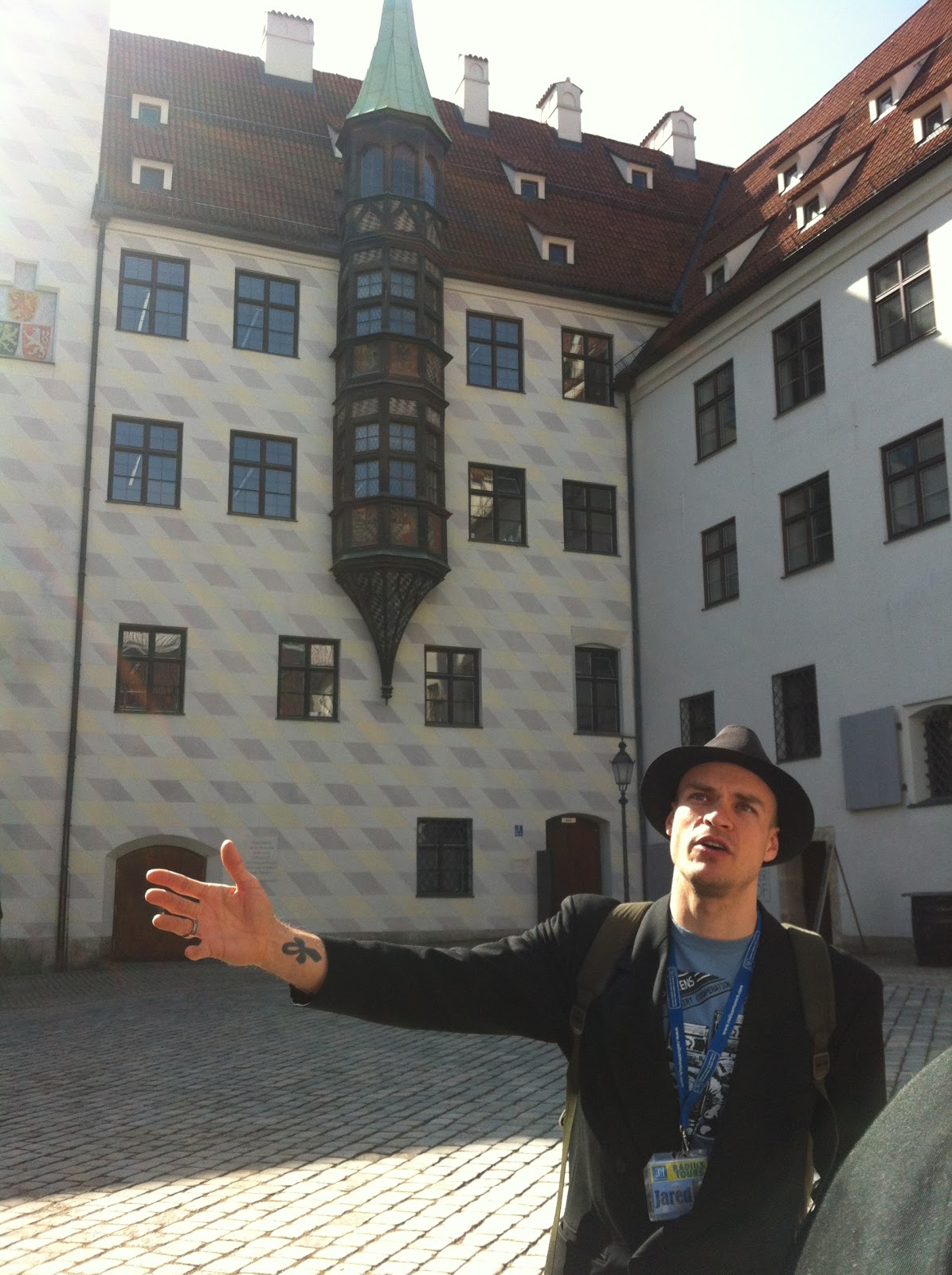
Our Guide

Max-Joseph Platz

Theatine Kirche

Clinton on Odeonsplatz

Theatine Kirche

We traveled through a number of other city streets and ended the tour in Odeonsplatz next to the Theatinerkirche.  By this point it was nearly 1:00pm.  After tipping for the tour, the guys went to see the inside of the church as I found a pay phone to make a dinner table reservation for later that night.  I would later be meeting up with Jan and Christian, two co-workers of mine from when I worked in BMW’s research and development center (FIZ) in 2011.  This was really my first time conversing completely in German on this trip, and I felt a little bit of accomplishment in how well I retained some of my speaking skills. 
Just before lunch, we went up in Old St. Peter’s bell tower to get the best city view offered for 1.00 Euro.  The view from that tower is astounding, and the nice weather made it all the more worthwhile.  After scoping out the Bavarian landscape from the church, we walked back to the market square to get lunch.  We stopped at a Metzgerei (butcher’s shop) that was recommended to us by our tour guide.  I chose to purchase the famous Leberkäse sandwich.  Others bought various types of Wurst.  These are definitely the meats of Germany.  They are offered in most all cities, and you can be assured that potatoes are always nearby as well… whether mashed or in fried form.  According to our guide, many of German’s traditional foods have French origin.


Jordan and I in St. Peter's Bell Tower

We all enjoyed our meal along with a beer in the city Biergarten (beer garden).  It was explained to us that while Americans have community pools for swimming, Bavaria has community Beirgartens for drinking.  I laughed, because I knew it was a true statement.  While the guys all had a Mass of helles beer (1 liter of light beer), I had what is known as a Radler (beer with lemonade whose name literally translates to “bicyclist”).  At first, I wasn’t a big fan of this type of beer, but it grew on me last year.  It is a nice and refreshing beer for breakfast or lunch.  Along with those beers, I decided to be daring and try a new kind of meat.  They actually sold horse meat at this market!  I went and purchased two variations of the Pferdefleisch and shared it with the group.   Honestly, it was not distinguishable from any other type of meet I’ve ever had… but now I can say I’ve tried it.

Pferdefleisch mit Senf

As we sat there, we had an extensive conversation about how well a Biergarten would go in an American city such as Cincinnati.  We discussed some of the political, legal, and cultural implications of actually undertaking such a business venture.  I think we were all advocates for making it happen.  We said as much in jest, but I personally think Cincinnati could host such a venture.  I believe Christian Moerlein’s initiatives downtown are helping shape this possibility. 

After the meal and a short reprieve, we began walking north of the Altstadt.  I wanted to take the group through the Englischer Garten (English Gardens), but time only permitted that we see the southernmost portion of the city park.  We were able to catch some surfers on the river rapids at the park entrance too.  Very cool!  Once three o’clock chimed, we kicked it in gear to get to BMW on time.  Our tour was at four and I didn’t want us to miss it.  We made our way to the U-Bahn station (subway station) and I bought us some group tickets so we could take the rail line up to Olympia Park where the BMW Welt (BMW World) is located.  We made it with five minutes to spare!

River Surfers

I am very grateful that I made the tour reservations several weeks ago.  These plant tours book up quickly, and one of the reasons I never went on one last year was because I waited too long to book a tour.  Unfortunately, two other UC MBA students who were in Munich with us could not join the tour because it was sold out; however, for the rest of us, the 5 Euros (after a nice student discount) was a very fair price for what we saw. 

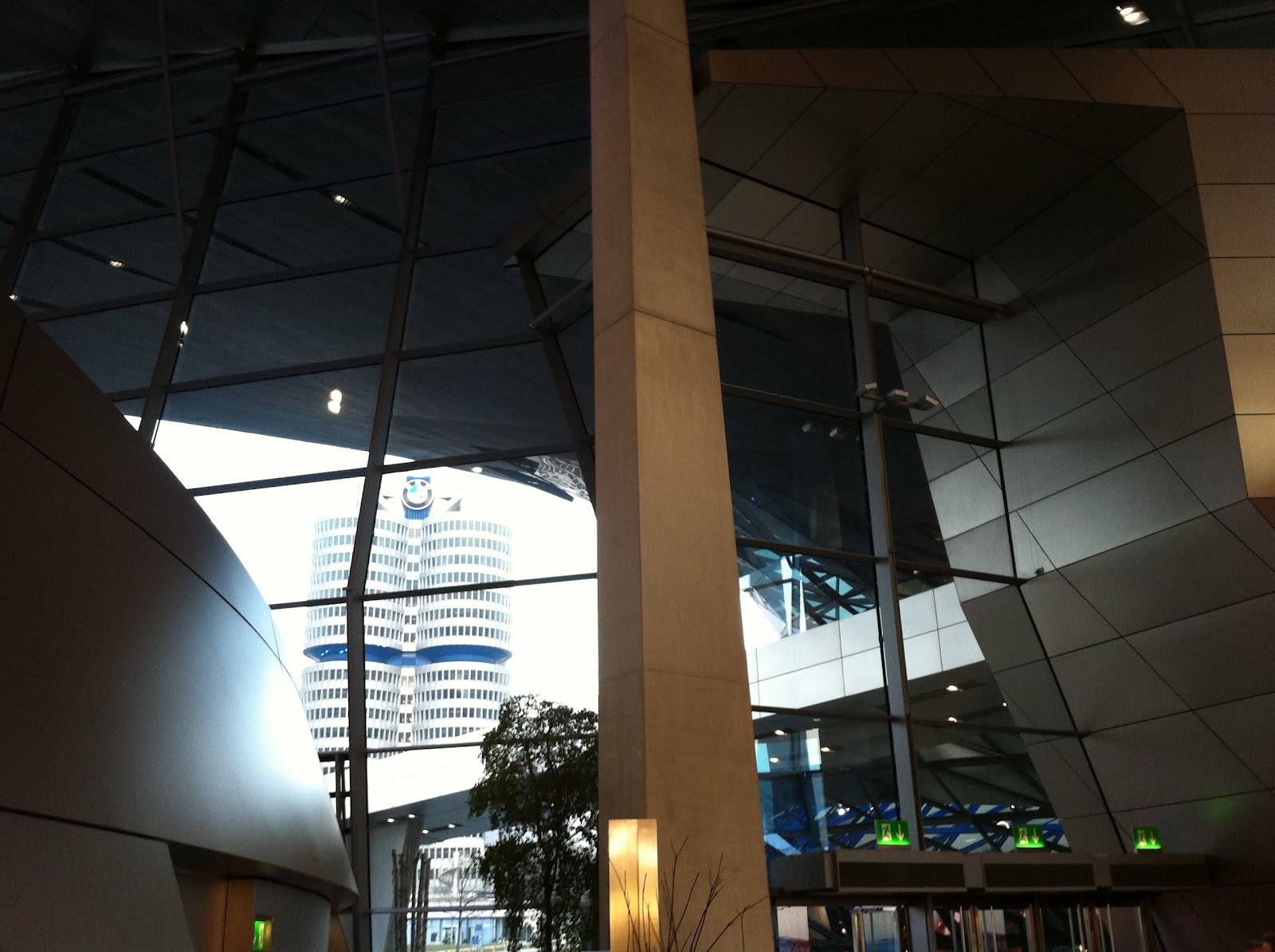
BMW Headquarters (4-Cyliner)
 The production facility was incredible to see, and varied greatly in some ways from the Toyota manufacturing facility I toured three weeks ago.  The biggest constraint on Munich’s BMW plant is the space available.  As one of the only inner-city car manufacturing plants in Europe, BMW has some unique production facility challenges they face on a regular basis.  I believe it was mentioned at the tour’s start that the plant had a capacity of 900 cars per day.  In Munich, variants of the Three Series are manufactured daily.  We started the tour in the press shop and proceeded to welding.  The level of automation was astounding and the plant was extremely clean.  I was amazed at just how little clutter, dust, and dirt was present. In comparison with the Toyota plant, this place was pristine.  I’ll comment more on the comparisons in another post.

After welding, we witnessed paint, engine assembly, full car assembly, and final inspection.  As we exited the plant, we could see the brand new vehicles driving onto the train cars located right at the plant exit.  These BMWs would be brought up north to the port, where they would be shipped all over the world.  The process was an incredible one to observe and the tour lasted nearly two hours.  Once back at BMW Welt, we explored some of the displays and exhibits before dispatching for the evening.  We were going to attempt a video blog, but were unable to do so because of a dying camera battery. 

Jordan at the Wheel

Eric, Paul, and Dan at BMW


BMW Welt

At this point in the evening, it was about 6:30pm.  I made some recommendations to the guys on what places they should visit for the evening, and I then broke off to meet up with my German friends at Blücher Café.  It was nice walking through the familiar streets near where I lived last year.  It was hard to believe it had been over seven months ago that I had last walked these streets daily.  When my friends arrived at 7pm, it was a wonderful reunion.  We had a great meal and several drinks along with much good conversation.  We talked for nearly four hours before realizing it was getting late.  This is what I recall best of German culture.  Time is less bounded at meals and the atmosphere is what is commonly referred to in Germany as gemütlich (literally translated to “cozy”).

Our conversation was all spoken in German, and I was excited to see that my speaking skills hadn’t deteriorated too much since last fall.  I guess language can be like riding a bike… at least in the short term.  It also reminded me of how much easier it is to immerse in a culture when you know the langue well.  We had some more “culture sharing” later in the night, when I pulled out the gifts I brought from America.  I towed along four of Cincinnati’s Christian Moerlein brews for them to try at some point.  The concept of a microbrew is not well known in Germany.  Most of their beers are light, dark, or wheat.  There is very little variation outside of this.  American microbrews tend to have a unique and wide spectrum of distinct tastes.  Since the guys had introduced me to so many types of German beer last year, I thought it would be nice to return the favor by offering some Cincinnati culture.

The night ended well as we wished each other luck and good health until our next encounter.  Perhaps next time, they’ll be making a trip to America!  I returned to the hostel around midnight and promptly went to bed.  I was up early this morning for breakfast and some writing.  I now sit on a Rail Jet (train line) on my way to Linz.  We left Munich at 11:30am and should arrive in Linz not long after 2:00pm.  In fact, we just passed through Salzburg, where I could recognize some familiar mountains.  I look forward to the start of our MBA program.  I have never been to Linz or Prague, so it will be exciting to see something new.  I’ll be in touch after we arrive!

On our way to Linz!