Showing posts with label Austria. Show all posts
Showing posts with label Austria. Show all posts
Wednesday, March 21, 2012

[TRAVEL LOG] STEEL = STAHL AUF DEUTSCH
Yesterday was all about steel. What is the biggest reason that Linz is such
a prosperous city today? Steel. To
begin, let’s explore some background information…
Before our tour of Rosenbauer on Monday, our bus driver
actually took us through a small village just outside of Linz. He announced to us that we were passing the
childhood home of Adolf Hitler. He then
directed our attention to the cemetery that held the graves of his
parents. Hitler was not a native German;
he was Austrian (until 1925). He grew up
near Linz, and when he came to power later in life, he still had Linz on his
map of cities that would serve a great cause in his Reich. He established a
steel company in Linz going into the Second World War to fuel his armies with
steel. Tanks, airplanes, ships, and
artillery all required the precious commodity.
Linz became a major resource for Germany during the war.


At the end of the war, the plant was destroyed. The allies had destroyed much of it as a
means of cutting off resources to the German army. After the war, the city was split between the
allies just as Berlin was. One major
difference, however, was that the city center was not designated towards any
particular country. Each occupying
country took turns occupying this portion of the city. Eventually, much would be turned over to the
Americans. In the 50s, the Americans
helped to restart the Linz economy by reviving the steel plant. Two blast furnaces were reconstructed and the
plant began production again. For years
it would operate as a state owned company.
In 1995, Voestalpine (the name the steel company had been given), made
its IPO and went public. At this time,
many investors were able to buy stock to take part ownership of the steel
giant. It is now 54% state owned and 13%
employee owned. As with many company
histories in central Europe, it has a long and interesting story. Sometimes this history contains some darker
periods. Voestalpine does not take pride
in the fact that it once fueled the German war machine, but it does do well to acknowledge
this very important part of the company’s history and use all past experiences
to build on and move the company into the future.
Our group of MBAs traveled to the plant and met with a
couple of their representatives at 10am yesterday. The initial presentation gave an overview of
the company’s past, present, and future.
Anita Friedl from Corporate Development gave the initial talk on the
global steel market. Today, the industry
is booming because of significant growth in China. The current top two market leaders in steel manufacturing
are actually in China (the market leader) and the USA. Actual company market leaders are 1) ArcelorMittal,
2) Baosteel, and 3)POSCO. The US top
manufacturer, US Steel, falls in at number 8, while Voestalpine, Austria’s top
manufacturer, falls in at number 29 globally.
Voestalpine employs 12,000 employees locally and supports more than
200,000 area jobs. Over 1300 apprentices
work at the plant and 500 employees are dedicated solely to research and
development, including research in environment protection initiatives. Voestalpine prides itself in being the
cleanest steel mill in Europe, and possibly even the cleanest in the world. Due to recent initiatives (and regulations by
the E.U.), the mill has managed to reduce its polluting emissions by nearly
95%. For this reason, Linz has some of
the cleanest air of any city in Austria.


Voestalpine has five separate divisions and employees nearly
41,000 employees globally. Divisions
include steel, special steel, profile form, rail systems, and automotive. In 2010, they brought in nearly 11 billion
Euro in revenue. They are spread between five continents and 60 different
countries. Major partners include
companies like BMW, Audi, Ford, GM, Daimler, Fiat, Peugeot, and other auto
manufacturers. They hold a number one
position in rail technologies specifically.
They are even able to produce steel rails as long as 120 meters! …and ship them successfully!!
The next corporate development representative, Rene
Killinger, gave an overview of the company’s look into the future. The motto “One Step Ahead” was very prevalent
throughout the company grounds and in all of their branding. Four focus areas were explained in which the corporate,
business, and functional company strategies all converged. These were 1) a focus on niche and high
quality/technology market divisions, 2) continuing to offer a large product
variety, 3) avoiding “spot market” exposure, and 4) creating a longer value
chain.
For all you “non-business” types, I apologize for all of the
jargon. One part of this trip is that I
give some focus to the “business” side of things out here. In general, the concept of an “MBA” is more
of a new one in Europe than in the US.
We sort of pioneered this idea of a business focus. It is neat, however, to see how the “talk” is
the same in Europe. Business concepts
have become more standard worldwide, and I can see how this is leading towards
a more global economy. Cooperation
efforts, plans, and joint strategies become more productive when language and
concepts align at a basic level. It is
the nuances of the business structures that make observation of foreign
business interesting. For Austrians,
competing at an international level is almost necessary because of their country’s
small size. In American, many companies
do not need to extend past our borders because the US alone “supplies” enough
“demand” to businesses. With that small
interlude, allow me to continue with Voestalpine…
Just as with any other steel manufacturer, Voestalpine is
taking a serious look at what the future of the industry looks like. With new material development in the auto
industry and ever changing means of transportation in the world, the future
demand for steel is largely uncertain.
To prepare for such a future, workshops within the company have been
assembled to discuss the outlook and make recommendation to the company board.
In terms of other growth, I mentioned its look value adding
processes. This is a downstream growth
strategy that would include adding processes to make the steel worth more to a customer. For example, I could sell you a steel plate
OR a steel spoon. If you are a chef,
which is worth more to you? The steel
could weigh more, and therefore have a higher value to a steel maker, but you
gain more use out of the spoon- not the amount of material. Because of this, you would pay more for the
spoon than the plate. The process that
made the steel bar into a spoon is a “value adding process”. Voestalpine is looking at which of these they
can add to their company to increase profitability. One example is that they are now stamping and
welding together various grade steels for car body panels for BMW. This is a process BMW outsources.
One final subject of the morning involved the
business-worker relations. We discussed
how the company did not lay anyone off in the recent economic crisis. Costs were cut heavily and the Chamber of
Labor was able to provide funding for special job training in slow
periods. The concern of an elderly
working class once again came up, and it was described how these workers were
then placed with jobs fit to their physical abilities. Getting younger workers
in the door is something Voestalpine is focusing on, and they are doing this
through joint work with educational institutions such as JKU. In Austria, apprenticeships are very common
and many students will work and study jointly.
This gives sufficient training and helps more effectively bring youthful
employees into the company. This is all
very similar to the co-op program our university utilizes.
After our morning discussion, we had lunch in the company cafeteria. We then were lead on a guided tour of Stahlwelt (Steel World), their visitor center, and the plant itself. Our guide was very informative and took us through each step of the steel manufacturing process. On the plant tour, we took a bus to each of our stops. The plant is literally a city of its own. It has its own police, fire department, and health center. We stopped first at the larges blast furnace (capable of 800 tons of iron ore production per day) and then we stopped at a portion of the plant where stamped steel panels were being welded together for BMW.


The trip to Voestalpine took up the entire day, but was very
educational. Between the history,
engineering, and business information gained, I know my mind was
exhausted. It was, however, a good way
to end the Linz experience. Some of us
guys later when to a frequently visited café behind the hotel for dinner. We mentioned to the waiter that we were from
UC, and he promptly handed us a guestbook to sign. The place was called Johann’s. We could actually see a few entries in the
guestbook where other professors and university affiliates had signed in the
past. Jordan sketched in a giant c-paw
in the book and we all signed. For
anyone visiting in the future, we left a tally of how many “beverages” we
purchased there. Our challenge to you is
to support this local business by beating our tally.
For as small as Linz was, there was much to discover. I’m glad to have been there and experienced
the scene. I now am onboard a Westbus
bus (operated by the same company as Westbahn) heading for Prague. We left at 9:20 am this morning and should
arrive in Prague around 2:30 pm. We’ll
be having another welcome dinner later this evening. I look forward to reporting from there!

[TRAVEL LOG] WIEDER ARBEITEN – ARBEITSKAMMER UND ROSEN BAUER
As the title above claims, we were back to work today as we
visited the Chamber of Labor in the morning and the fire truck and equipment
manufacturer, Rosenbauer, in the afternoon.
At 9 am, we traveled to the Arbeitskammer (Chamber of Labor) met with leaders from the Chamber of
Commerce, Chamber of Labor, and the Workers’ Council of Voestalpine. Also in the mix was a representative from an organization
representing consumer information of Upper Austria. The informative session lasted about three
hours and proved to be very informative of the government/business/worker
relationship in the country of Austria. In
many ways the system varies considerably from that of the United States. In others, there are similarities. We learned of how this Social Partnership
worked and gained a good overview of what each chamber did regarding businesses
in Upper Austria.
 |
| Chamber of Labor |
Mr. Martin Seidl began by speaking of the Chamber of
Labor. Basically this chamber works with
the workforce and represents them in assessing laws and regulation
proposals. They also administer health
insurance and labor market services.
Legal advising and representation may be found for labor and social
security cases. They also offer
educational services, cultural programs, and other consumer information. These roles are a bit more abstract from
those of the chamber of commerce.
Mr. Robert Leitner spoke to us of this second body. The chamber of commerce focuses more on work
with the business community. They
support work councils, help determine wage and salary settlements, and have
optional membership, unlike the Chamber of Labor. Because of the country’s small size and its
many family owned businesses, the collaborative efforts of this chamber are
more functional in Austria. Today, many
of the chamber’s initiatives are centered on youth employment (with many
current youth “getting lost” in the education system), the national health
system (because of the aging population), old age pension schemes, the labor
market, and integration & migration.
Both of these chambers then work with labor unions and work
councils. Today’s representative from
Voestalpine was the elected work council leader for that company. Many workers will come to him before ever
reporting to a manager or foreman about a problem. He helps decide where wages are set and money
from the government is placed in departments.
His chief goal is to ensure the workers have quality working conditions
and lifestyles. Concerns ranging from
divorce, marriage, births, and funerals will reach his office on a regular
basis. He described to us a resent
presentation he gave to the company on how they should readjust the shift
system to reflect America’s. He spent
extensive time in the USA observing our system and found many ways to improve
working condition quality through simple changes.
Our fourth speaker, Dr. Georg Rathwallner was very helpful
in explaining the office of Konsumenteninformation
(Consumer Information) of Upper Austria.
Operated through the Chamber of Labor, this office provides consumers
with price calculators (in finding cheap banks and utilities), as well as
health testing and other information on consumer products.


They were VERY accommodating and professional in hosting us. We were provided with plenty of study material, refreshments, a Salzburg malt ball, and a baseball cap! Not only did they provide refreshments for the morning session, but they also treated us to a three course meal for lunch!
The restaurant was Austrian and they served three types of Schnitzel. Chicken, fish, and beet were the three options available for the main course. For starters, we had a nice tomato soup and bread. To finish off the meal was my favorite German dessert… Apfel Struedel. Hmm… And the best part was that part of the profits from the restaurant went towards worker training and services to the unemployed of Linz.


After the almost 1.5 hour lunch break, we took our bus to Rosenbauer. Here we visited the world market leader in fire truck and rescue equipment technology and manufacturing. The tour was very different from that of the BMW plant where consumer products were mass produced. Here, smaller orders were being made from the public sector all over the world. The manner in which the trucks are manufactured is much slower and time consuming than for consumer cars. In some steps of the manufacturing process, such as that for making pumps, a single worker bears the responsibility for every step to ensure quality.
Before taking our tour of the plant, we met with CEO, Dieter Siegel. He is the 6th generation family owner of this company started back in 1866. He did an excellent job at explaining the company’s background, history, and current status. In 1866, it was simply a trading company, but began to work on fire fighting pumps in 1906. Fire vehicles began in 1919 and the company finally went international in 1926, selling trucks to China. As early as 1976, half of the company’s income came from its exports. In its most recent history, it opened plants in North America in 1995 to capitalize on western market opportunities. It is now the world market leader and really the only international fire vehicle manufacturer. Although it began as a private family corporation, it is now publically traded with a family ownership of 51%.


 |
| CEO of Rosenbauer, Dieter Siegel |
As recent as three decades ago, Rosenbauer began to focus on more innovative design and technology as their company’s primary focus. Unlike some more traditional fire truck and fire equipment manufacturers, Rosenbauer products are constantly developing and adapting in very new and creative ways. Their products consist of over 70% fire vehicles, of which 20% are being sold to airports across the world. These trucks need to be capable of hauling as much as 10,000 liters of water to any part of an airport in less than 2 minutes. That is incredible! I recommend all readers to check out their website for more information on the truck specs.


In 2010, the company had sites in 15 locations around the world. Three are in the USA. Just over 2000 employees worldwide work for Rosenbauer. The process of making just under 2000 trucks a year involves some more creative thinking. Making every component in house would be very costly. Toyota makes more than this many cars in ONE DAY at ONE PLANT. Motors and chassis are largely outsourced to other companies for manufacturing. These commercial products greatly reduce the necessary resources needed by Rosenbauer for manufacturing. Rosenbauer takes these outsourced parts and then completes the most critical machining, assembly, and adjustment processes in house. In total, it takes nearly 5 weeks for one truck to be completed.
When Mr. Siegel was asked what sets them apart from competitors, he gave four responses.
- They operate on small scale production and utilize 100% pre-engineered parts.
- They are the biggest and only international brand.
- They work with firefighting standards from all customer countries. This means they are flexible and have very high standards overall.
- The company is 51% family owned. This shows investment and longevity. Sustainability is assured to customers.
Overall, the company was very impressive and showed just how relevant world markets are becoming today. I was especially intrigued by the notion of really adapting to standards in other countries. This would be both a challenge and a quality-building incentive. When Siegel explained their USA operations, he said that they began with American engineers and leadership. Since American firefighting is so much different than European (for example, we use more water and less foam in fighting fires), Rosenbauer entrusted much of the American plant development to American businessmen and engineers. Today, this component of the company is very successful.
Although we didn’t get to ride in any trucks today, the visit was very educational. I know if I were a graduating engineer, this would be a very lucrative place to work! …building giant trucks, water cannons, and saving lives internationally through technology.
Sunday, March 18, 2012
[TRAVEL LOG] SUNDAY IN VIENNA
How many engineers does it take to split a lunch bill? Apparently it takes eight. Ten minutes after receiving our check at a pizzeria
in Vienna today, we were able to determine that the unaccounted for 10 Euros
was due to a “table charge”. This was
that illusive included tax we had always been told about. Each table that we took up in the outdoor
portion of the café cost 2.50 Euros.
Reassured in our ability to count, we realized we needed to work on
reading receipts. Despite the simple
task of splitting a single bill, I don’t think any of us would object in saying
that we really appreciate American restaurants which are willing to accommodate
individual checks in large groups!
So yes… today was a day trip to the capital of Austria…
Vienna! Or Wien, as recited in its true German form. Most people would know this as the hometown
of Sigmund Freud or the originators of the infamous Wiener Schnitzel (Viennese
Veal Cutlet). It is the largest city in
Austria and contains almost 25% of its population at just fewer than 1.75
million people. Throughout history, this
city has been a cultural epicenter in Europe, particularly in academics and
music. Today, concerts and operas take
place on a regular basis. It is also
known for its large traditional balls (i.e. balls that take place in ballrooms). The city is sprawling and contains innumerable
historic squares and buildings. Today, this
is considered by many the top city when considering culture, markets, and
infrastructure. Urban planners today use
Vienna often in their studies.
Our trip to Vienna began this morning at 8:45am when the
Westbahn train line took off from Linz station.
This is a new train line in Austria that connects major cities in a
single route between Salzburg and Vienna.
The brilliance of this line is its affordability and accommodations. We purchased no ticket, but rather paid on
the train after it set in motion. The
tickets were under half the price of a regular OEBB ticket and the cabins were
much nicer. The trains even had free
wi-fi! This is unheard of in most of
Europe.
 |
| Vienna Train Station |
 |
| Walking to the Inner City Ring |

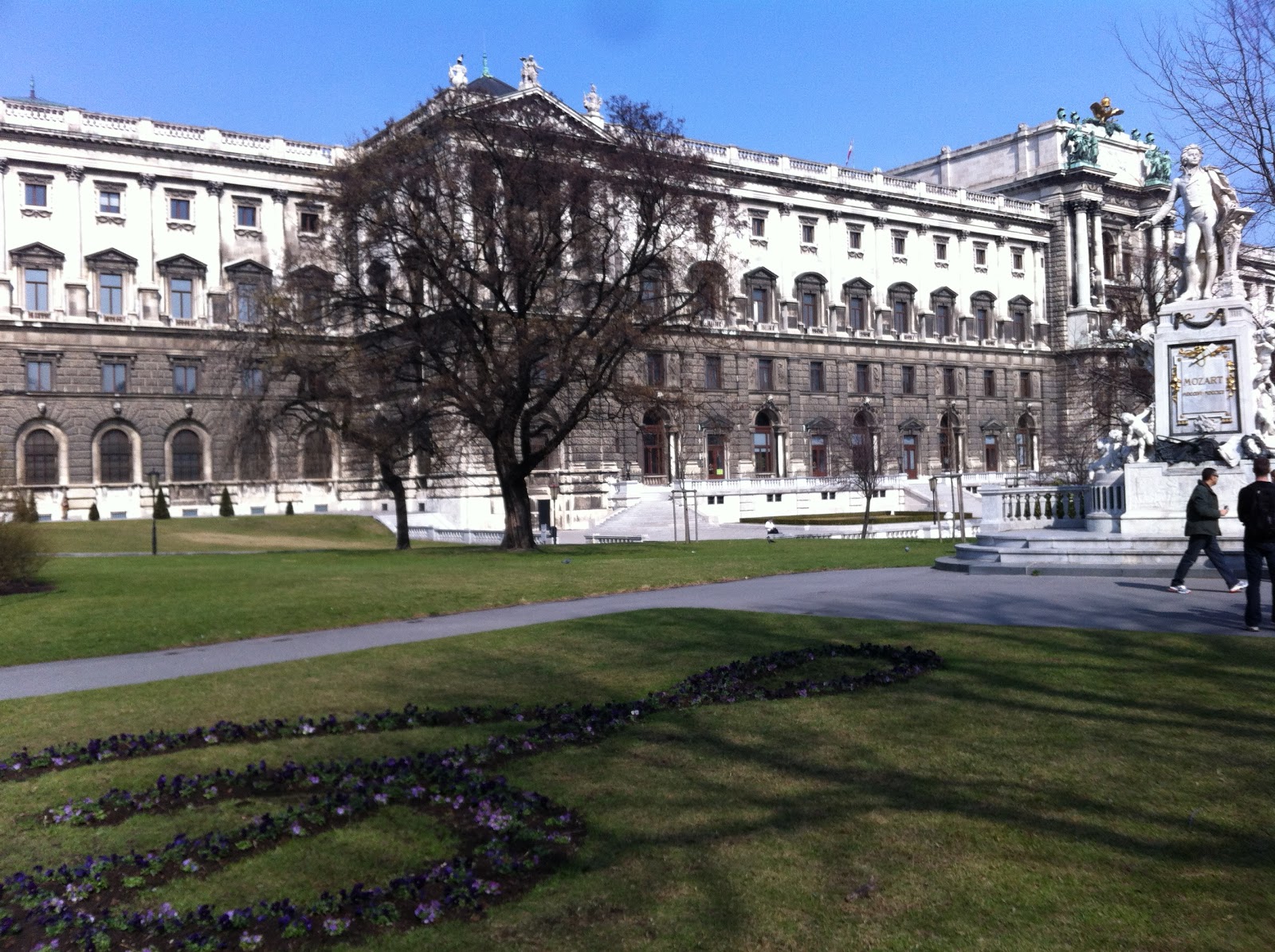


One of our first stops was the St. Stephan Cathedral which
was built in the 1300’s. The cathedral
was massive, and its roof was of particular interest. It bore many colored shingles to form the
image of the city’s crest. Amidst the
spires and entrances were ornate carvings and figures. Again, I was shocked at the level of detail
that went into such masterpieces back in those medieval days. We finished our visit with a trip up the old
bell tower. The view was
spectacular. We also learned that the
Vienna fire department used to keep watch over the city from this tower
chamber. …a great use of resources!
 |
| St. Stephan Cathedral |


 |
| Former location of the old 20,130 kg bell destroyed in WWII |


We had lunch after this, sharing a few pizzas. In Europe, when someone orders pizza, it is
expected that they eat the entire pizza.
Granted, the pizzas are much thinner, but the amount still seems like a
lot. When we told the waiter we wanted
to split them, he looked at us as if we had three heads each. Some American concepts don’t quite fit into
other cultures.

 |
| Dan and I demonstrating a proper "Prost" |


All in all, the day was well spent. It was nice to return a bit earlier so we
could relax after a long day of walking in the sun. Tomorrow we’re up bright and early for a
session downtown and another company visit.
Subscribe to:
Posts (Atom)