Showing posts with label Touring. Show all posts
Showing posts with label Touring. Show all posts
Friday, March 23, 2012

Sunday, March 18, 2012
[TRAVEL LOG] SUNDAY IN VIENNA
How many engineers does it take to split a lunch bill? Apparently it takes eight. Ten minutes after receiving our check at a pizzeria
in Vienna today, we were able to determine that the unaccounted for 10 Euros
was due to a “table charge”. This was
that illusive included tax we had always been told about. Each table that we took up in the outdoor
portion of the café cost 2.50 Euros.
Reassured in our ability to count, we realized we needed to work on
reading receipts. Despite the simple
task of splitting a single bill, I don’t think any of us would object in saying
that we really appreciate American restaurants which are willing to accommodate
individual checks in large groups!
So yes… today was a day trip to the capital of Austria…
Vienna! Or Wien, as recited in its true German form. Most people would know this as the hometown
of Sigmund Freud or the originators of the infamous Wiener Schnitzel (Viennese
Veal Cutlet). It is the largest city in
Austria and contains almost 25% of its population at just fewer than 1.75
million people. Throughout history, this
city has been a cultural epicenter in Europe, particularly in academics and
music. Today, concerts and operas take
place on a regular basis. It is also
known for its large traditional balls (i.e. balls that take place in ballrooms). The city is sprawling and contains innumerable
historic squares and buildings. Today, this
is considered by many the top city when considering culture, markets, and
infrastructure. Urban planners today use
Vienna often in their studies.
Our trip to Vienna began this morning at 8:45am when the
Westbahn train line took off from Linz station.
This is a new train line in Austria that connects major cities in a
single route between Salzburg and Vienna.
The brilliance of this line is its affordability and accommodations. We purchased no ticket, but rather paid on
the train after it set in motion. The
tickets were under half the price of a regular OEBB ticket and the cabins were
much nicer. The trains even had free
wi-fi! This is unheard of in most of
Europe.
 |
| Vienna Train Station |
 |
| Walking to the Inner City Ring |

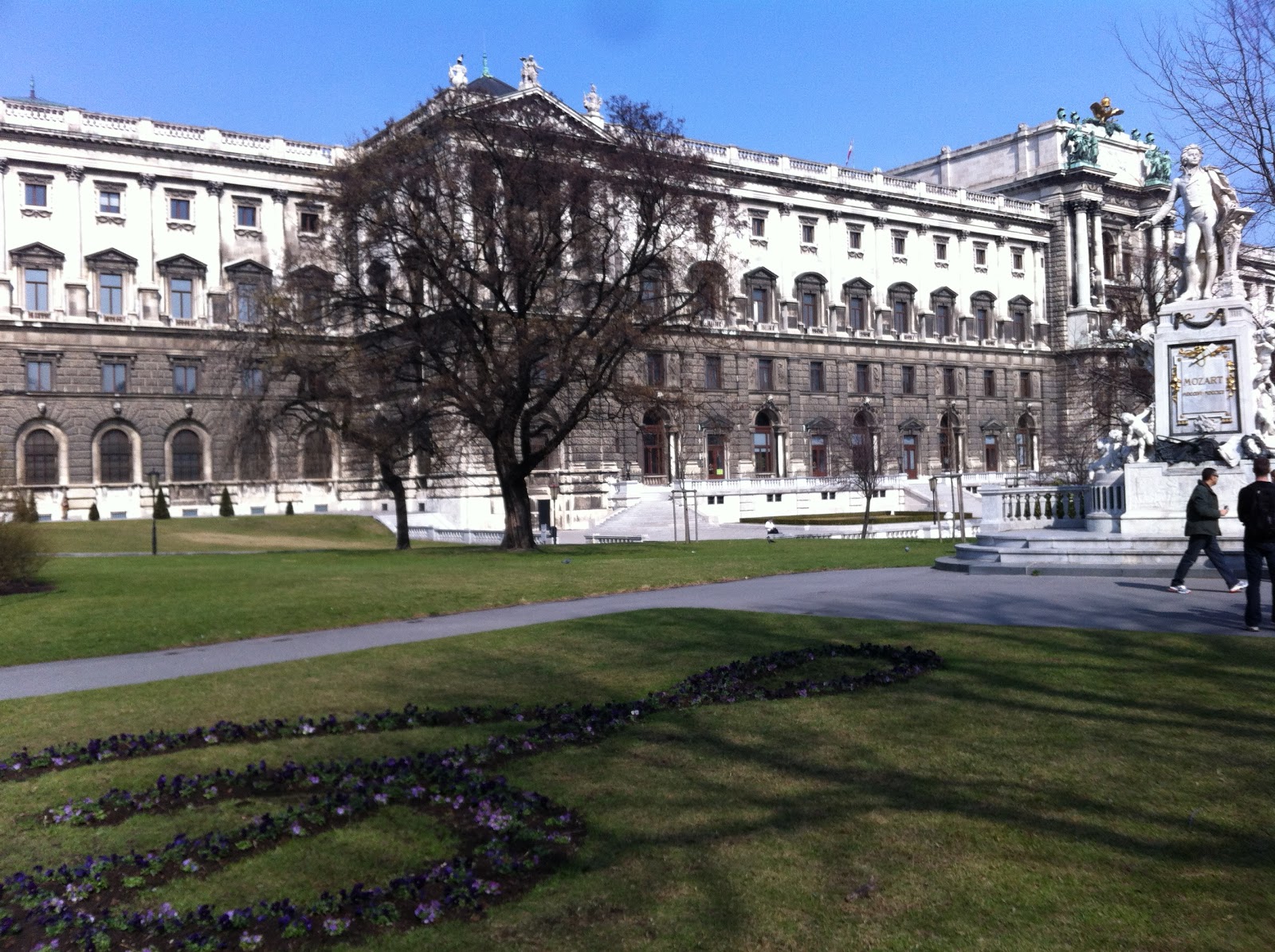


One of our first stops was the St. Stephan Cathedral which
was built in the 1300’s. The cathedral
was massive, and its roof was of particular interest. It bore many colored shingles to form the
image of the city’s crest. Amidst the
spires and entrances were ornate carvings and figures. Again, I was shocked at the level of detail
that went into such masterpieces back in those medieval days. We finished our visit with a trip up the old
bell tower. The view was
spectacular. We also learned that the
Vienna fire department used to keep watch over the city from this tower
chamber. …a great use of resources!
 |
| St. Stephan Cathedral |


 |
| Former location of the old 20,130 kg bell destroyed in WWII |


We had lunch after this, sharing a few pizzas. In Europe, when someone orders pizza, it is
expected that they eat the entire pizza.
Granted, the pizzas are much thinner, but the amount still seems like a
lot. When we told the waiter we wanted
to split them, he looked at us as if we had three heads each. Some American concepts don’t quite fit into
other cultures.

 |
| Dan and I demonstrating a proper "Prost" |


All in all, the day was well spent. It was nice to return a bit earlier so we
could relax after a long day of walking in the sun. Tomorrow we’re up bright and early for a
session downtown and another company visit.
Saturday, March 17, 2012
[TRAVEL LOG] LINZ TOUR AND POESTLINGBERG
Today was a day of Linz history and exploration. Since it was Saturday, we did not have any
class or company visits. Our program
did, however, manage to arrange a guided tour of the city for us in the
morning. This was a great way to get to
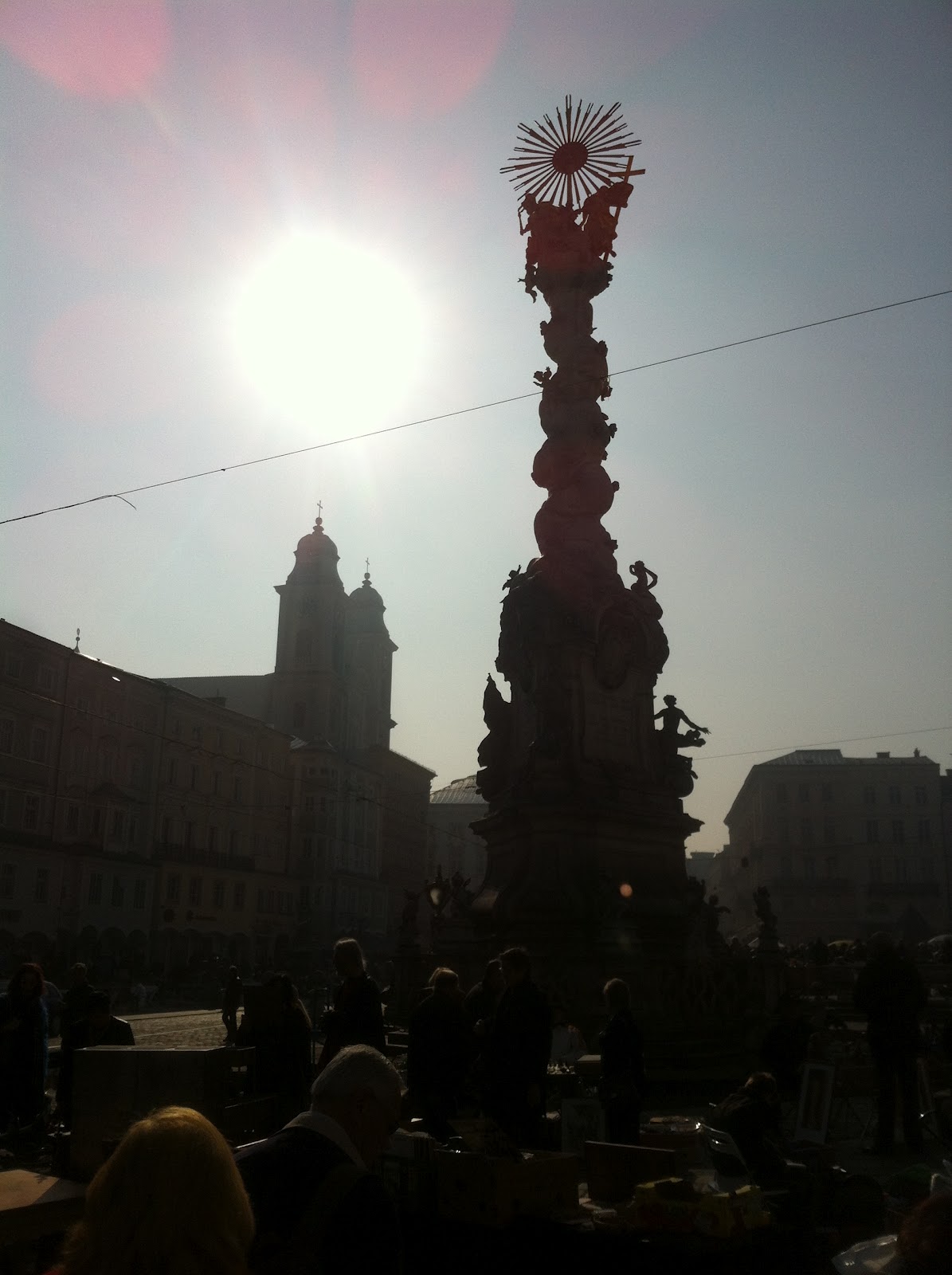
know the city even better than one could through a simple Wikipedia search. We began the tour in the Hauptplatz (Main Square) and eventually made our way through the
old city hall, the castle, and finally the new cathedral. The main
city layout is as follows:
 |
| Hauptplatz of Linz |
Linz is located between the major cities of Budapest,
Vienna, and Passau. These are cities
located on the Danube River. In the
north and south directions, Linz lies directly between Venice and Prague. Because of its strategic position in the
Austrian state, it developed into a major trading hub during the Roman
Empire. Other portions of its
development could be attributed to both political and Church powers. Because of a Jesuit college in the city, it
saw much growth in the middle ages. Even
before then, a Catholic presence was a part of the city. In the 700’s, the first records have been
found of what is now St. Martin’s Church (Martin’s
Kirche). We visited this church on
our tour. While at the church, our guide
touched on just how influential the Church had been on Linz’s, as well as the
entire state of Austria’s, development.
Today, many visitors will note that all Catholic holidays are typically
observed and that very few businesses are actually open on Sundays. For a long time, the Church bishops and
town/district rulers shared equal power or were the same person. In Linz, the Maria-Empfängnis Dom
(Maria Conception Cathedral) was constructed in order to exhibit the strength
of the Church. It is the largest
cathedral in Austria and was built to seat 20,000 people; Linz only had a
population of 29,000. Another
interesting fact about this church was that it faced north and south, unlike
traditional churches, whose nave ran east and west. This was so that the entrance of the state
political house faced the cathedral entrance.
This was to show that after the bishop led as head of state, he would go
immediately to serve the cathedral and God.


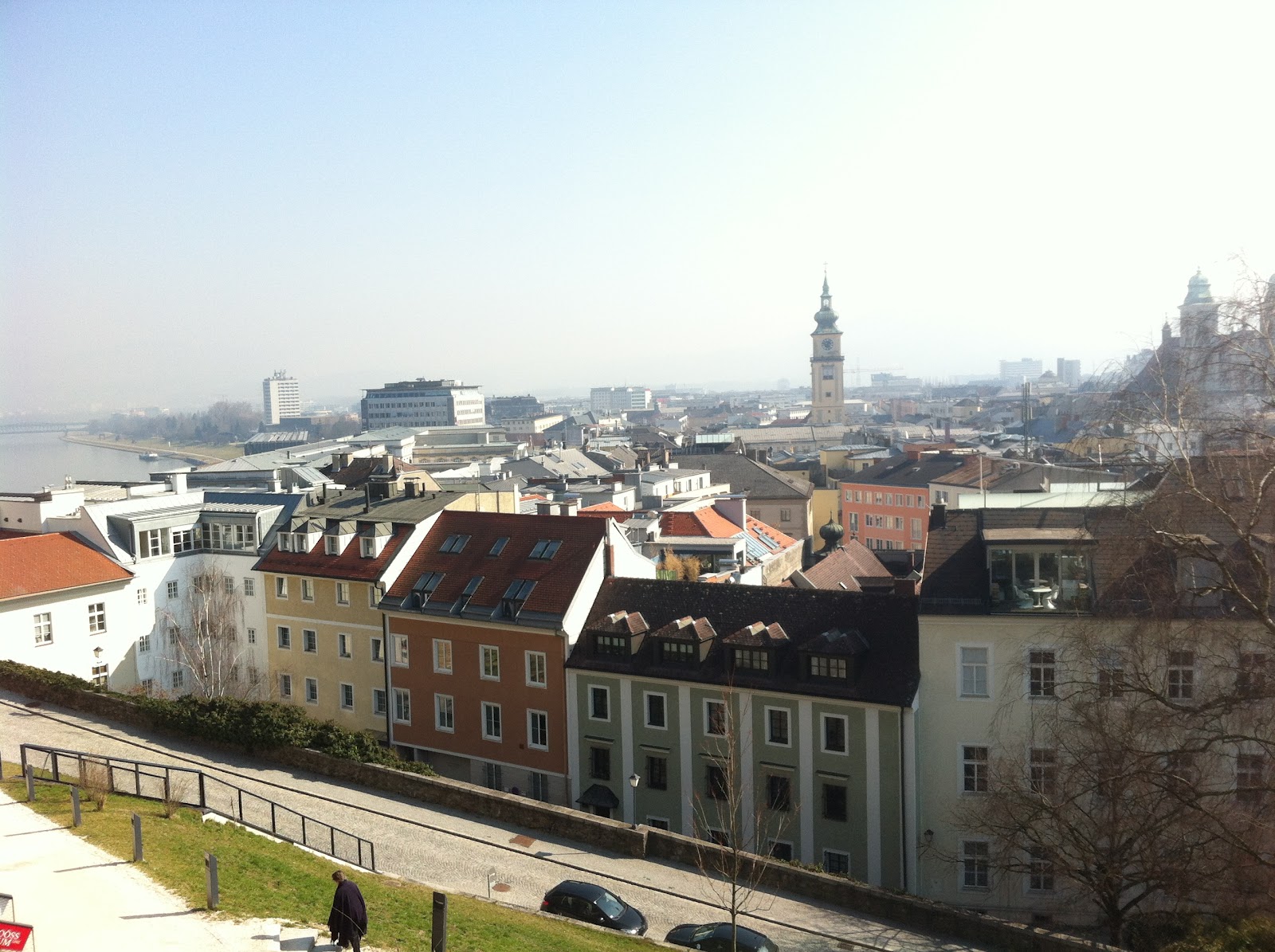


Past this older history, we were instructed on some of
Linz’s more modern history. Much of its
economic success goes back to involvement with Hitler. Hitler actually grew up in Austria, not far
from Linz. He lived in Linz for a large
portion of his Childhood. As an adult
and ruler, he had planned on making Linz a major part of his Reich.
Fueling the war machine was a steel mill he implemented there. Voestalpine, the steel mill we will be
visiting on Tuesday, was originally built to supply steel for German war
supplies. After the war, Linz was split
between the Allies, but eventually allowed to reunite under a new government. Today, the steel mill supplies much economic
success to the city.
As always, I am a huge history buff, so this tour was
especially interesting to me. I find it
fascinating just how different lifestyles have been throughout the ages. After looking at the closed-in,
moat-surrounded city of the older days, it is astounding to think that was the
hub of world trade. International trade
literally happened in peddler stands in an open air market in a town
square. Today, this would be unheard
of! BUT back in those days, this allowed
people to buy and sell. This allowed
people to specialize and have a higher quality of living. I’ll stop here, for fear of detracting more from
the post…
After the tour, seven of us decided to hike the great Pöstlingberg. This is a rather large hill with a pilgrimage
church located at the top. We decided to
reject the 5.60 Euro cost of taking the tram and walked up the hill. Around 30 minutes later, we found ourselves
at the top of the hill with a spectacular view of the city! See video post below:


In need of rest and some nourishment, we stopped at the café
located at the top and sat down for a nice lunch. I had a Vienna style pork loin and what I might
have to claim as my new favorite beer in Austria- Pöstlingberg Schlössl.

After lunch we visited the Wallfahrtskirche (pilgrimage church) which was named the “Seven
Wounds of Mary”. The church was gorgeous
and certainly made the hike worthwhile.
We marched right back down the hill after visiting the church and
immediately indulged in some gelato style ice cream once back in the main
square. Afterwards, the guys headed back
to the Hotel while I stayed behind to catch evening mass at the Carmelite
Church downtown. Many churches line the
downtown area, and all were quite beautiful.
It never ceases to amaze me just how gorgeous European churches can
be. Sometimes their décor and design can
throw a person off as well. In the Carmelite
Church (whose patron saint was St. Joseph), there were tombs of religious in
the side chapels. These were glass tombs
through which you could see the bodies of the deceased. For anyone not used to this in a more
contemporary American church, this might be a bit shocking. Nevertheless, the churches were very
beautiful, and attending a German mass again was a treat.


The rest of the evening was rather relaxed. I met back up with the guys at the
hotel. They watched some of the NCAA
tournament and I worked on some school work.
We later hit up Chinese for dinner.
Nothing like Americans having Chinese food from German menus in
Austria! Talk about some cultural
mixing! Tomorrow we head for Vienna
early in the morning. I am looking
forward to the day trip. Bis dann!

Subscribe to:
Posts (Atom)